
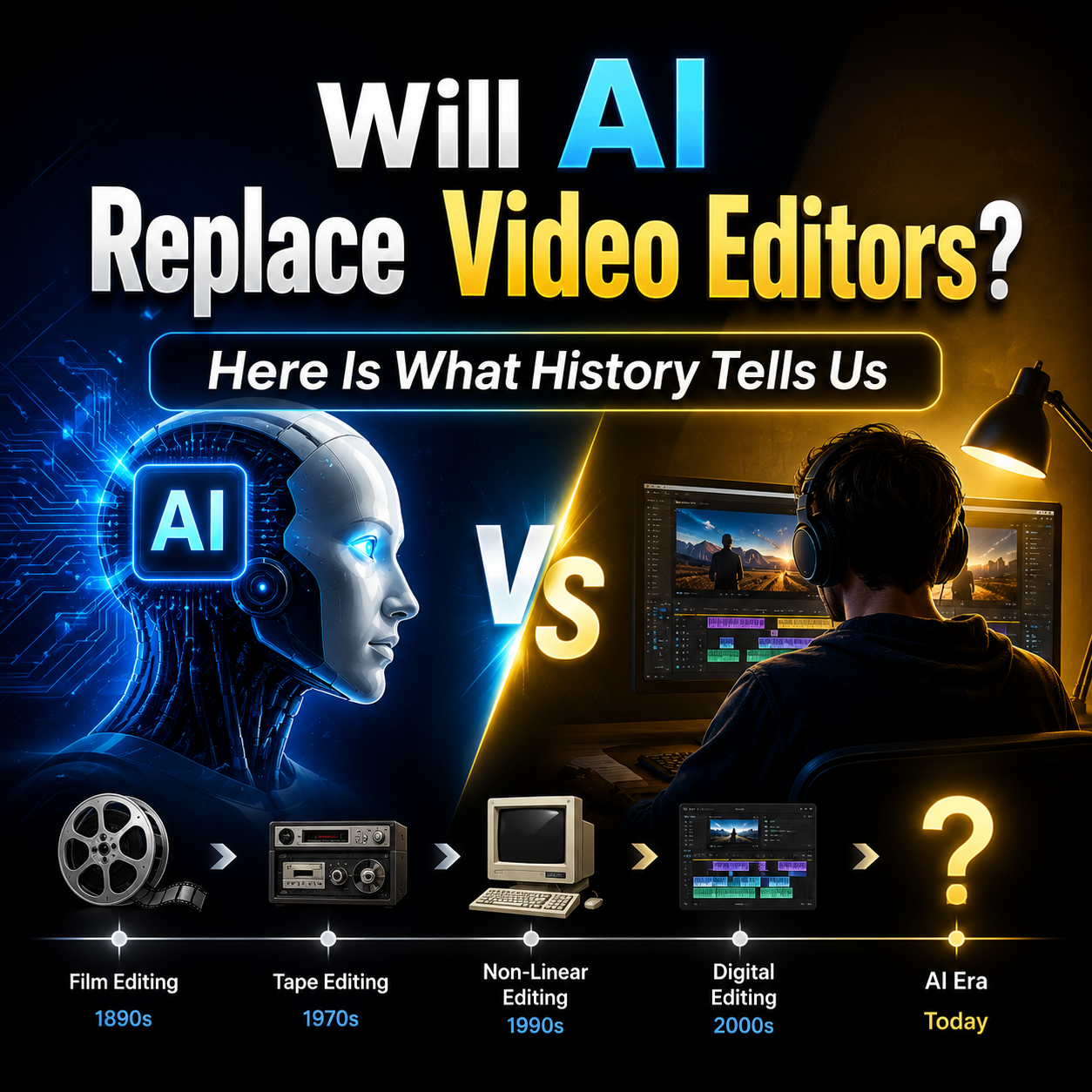
I asked myself this question when I started learning video editing. Runway, CapCut AI, Adobe Firefly — these tools are getting better every month. It is a fair question. And honestly, a little scary.
But here is the thing — this fear is not new.
We Have Been Here Before
Every major shift in video editing brought the same fear:
- In the 1990s, when non-linear editing software replaced tape editing — editors feared they would be replaced
- When Adobe Premiere and Final Cut became affordable and accessible to everyone — same fear
- When smartphones put a camera in every pocket and made everyone a “filmmaker” — same fear again
- When templates and preset packs flooded the market — editors worried their skills had no value
Each time, the opposite happened. The demand for video editors grew — because the demand for video content grew even faster. Tools lowered the barrier to entry, but they also expanded the entire market.
AI is following the same pattern.
What AI Can and Cannot Do
AI is genuinely good at mechanical tasks. Auto-cutting footage, generating captions, removing backgrounds, basic color correction — these are real capabilities that save hours of repetitive work.
But there is a ceiling.
AI cannot understand a brand’s personality and translate it into visual storytelling. It cannot feel the emotional pacing of a wedding highlight that makes people cry. It cannot read a client’s brief, ask the right questions, and deliver exactly what they imagined — sometimes better than they imagined.
That gap between mechanical execution and human creative judgment is where skilled editors live. And that gap is not closing anytime soon.
The Editors Who Will Struggle
The ones who only do mechanical work — simple jump cuts, templated social posts, cookie-cutter edits — will feel the pressure first. AI does that work faster and cheaper.
The Editors Who Will Thrive
The ones who combine genuine creative skill with AI tools. An editor who uses AI to cut their editing time in half can take more clients, charge better rates, or simply deliver faster. That is not replacement — that is leverage.
I am currently learning Premiere Pro and After Effects the manual way — building real skill and judgment from the ground up. At the same time, I am learning AI tools to work smarter. Both together is the answer.
The Bottom Line
AI will not replace video editors. It will replace editors who refuse to grow.
AI can automate tasks, but it can’t replace taste, storytelling, or the ability to truly understand what a client wants. In the end, the human eye still decides what works—and what doesn’t.
The question is not whether AI is coming. It already is. The question is whether you will use it as a threat or as a tool.
I choose the tool.