

“Most traders lose money not because of bad strategies, but because of over-trading. This is where the ‘Less Is More’ principle changes everything.”
The Role of Lifestyle in Trading Success
How important is lifestyle in trading?
A positive lifestyle—such as going to bed on time, waking up early, praying or practicing spiritual reflection, meditating, and exercising—may not give instant results, but in the long run it can provide traders with an extra edge.
Why does this matter?
Trading is one of the most discipline-demanding professions in the world. A disciplined lifestyle naturally supports disciplined trading.
On the other hand, even if a trader is not very disciplined in personal life (like me), they can still succeed in trading if their mindset, risk management, and money management are strong. However, in such cases, success usually requires a significant amount of screen time.
Still, even if everything seems right, someone may never succeed in trading—because trading is not for everyone.
What Is Screen Time in Trading?
Screen time refers to the amount of time a trader spends watching charts—both before entering a trade and after taking one.
For beginners, it often feels impossible to take their eyes off the charts. The more months or years someone spends observing price action, the higher their screen time becomes. Screen time plays a crucial role in developing a solid trading strategy.
However, after a certain stage, another concept becomes extremely important:
What Is the “Less Is More” Theory?
The Less Is More theory applies after gaining sufficient experience. By experience, I mean you have probably already blown a few demo and even real accounts. Through that process, you realize that something is even more important than strategy:
- Money Management
- Risk Management
- Correct Mindset and Emotional Balance
A strategy can always be back-tested. If 10 trades in a row hit stop loss, it clearly indicates that the strategy needs improvement.
According to the Less Is More theory, there is no need to stay glued to the market all day—unless you are a scalper. Even most scalpers trade only during one or two specific sessions.
With this approach:
- Trade entry conditions are pre-defined
- Exit conditions are pre-defined
- Risk and reward are pre-defined
Does this mean trading like a robot?
Not exactly—because:
Trading is widely considered both an art and a science.
My Personal Trading Approach
After entering a trade and setting the Stop Loss (SL) and Take Profit (TP), I usually do not manage the trade further. It will either hit SL or TP.
This approach does not work for everyone.
Since I trade on a lower time frame (M15), this method works for me around 50–60% of the time. However, on higher time frames, trade management may be necessary.
I usually check the charts every 1–2 hours between 2 PM and 10 PM (Bangladesh time). Sometimes, I only focus on the UK–US session overlap.
My process is simple:
- If there is a setup:
I take the trade, set SL and TP, and come back after an hour or so. - If there is no setup:
I return after 1–2 hours.
This works well for me.
The Less Is More theory also helps me manage trading anxiety.
Trading Anxiety, Money, and Risk Management
When money management and risk management are properly defined, trading anxiety becomes much easier to control.
Please see the images below:
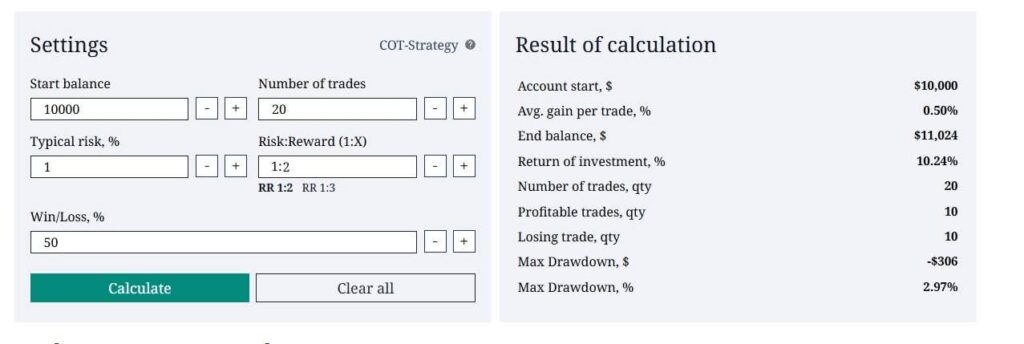
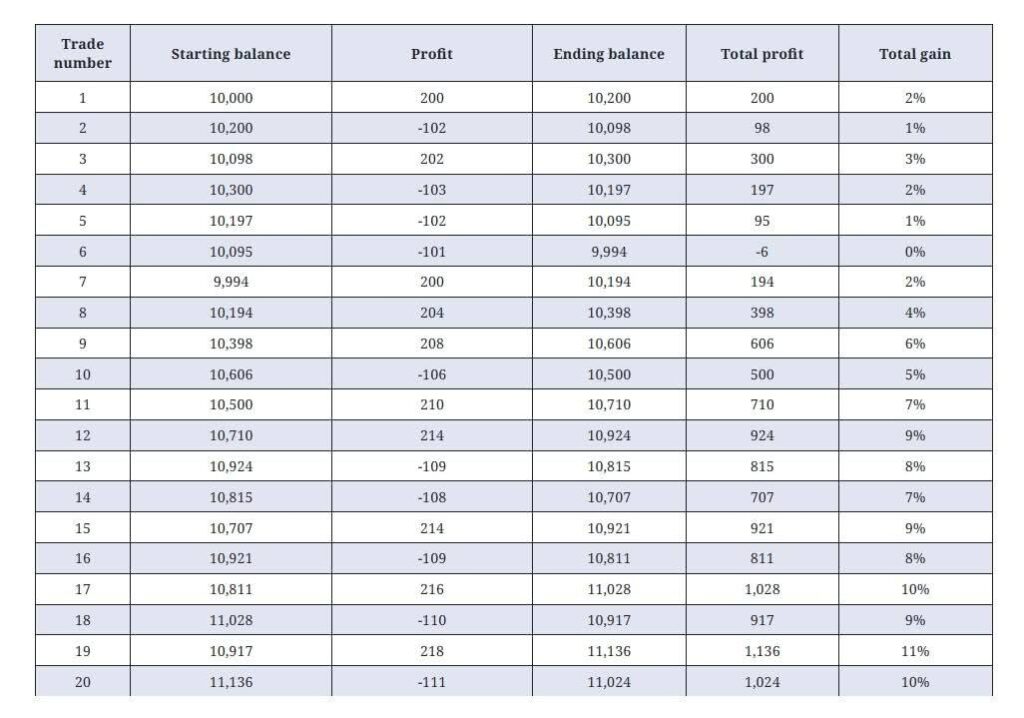
You can see:
- Win : Loss Ratio = 50 : 50
- Risk-Reward Ratio (RRR) = 1 : 2
Even with a 50% win rate, it is possible to stay around 10% profitable over 20 trades.
Before thinking about how much I will gain if I win, I first decide how much I am willing to lose if I lose. This is arguably the most important rule in trading.
Final Thoughts
I’ve shared a small portion of my understanding and experience here.
Please excuse any mistakes—I hope you’ll view them with kindness.